

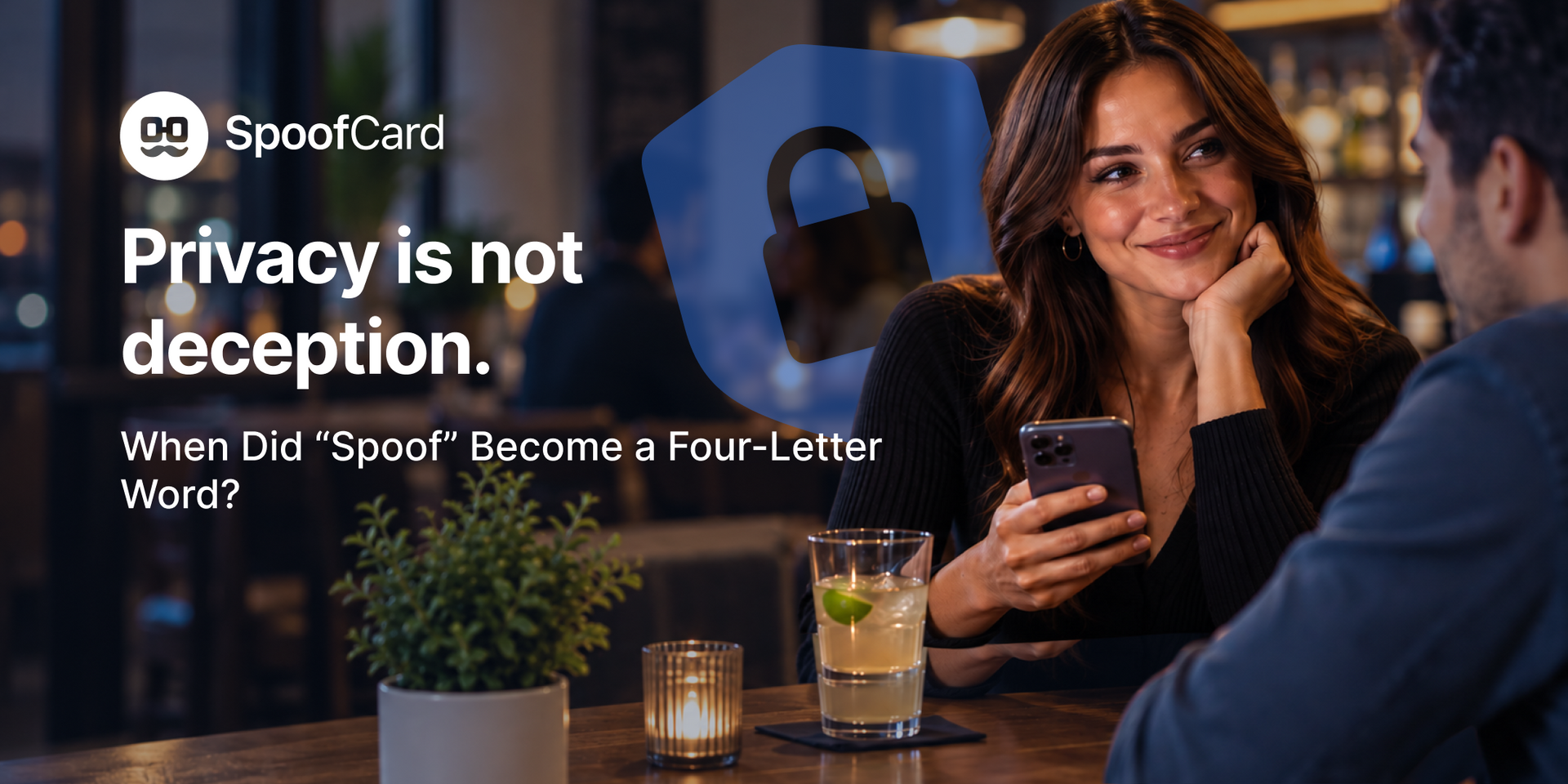
Let’s be honest. The word “spoof” has gotten a pretty bad reputation.
Say “spoofing,” and people immediately think scam calls. A fake IRS call. The person calling about your car warranty for the 47th time.
We understand why.
In the past, a “spoof” was defined as a humorous imitation or a light-hearted prank. But somewhere along the way, bad actors turned a technology that gave people more control over their caller ID into something that feels suspicious. We stopped separating the tool from the person using it, and we allowed bad actors to redefine a term that was once lighthearted and fun.
We protect our identities everywhere else.
Think about how much of your personal information you protect every single day.
You probably don't give every website your primary email address. You don't post your home address publicly. You might use a tool to hide your email address, a virtual credit card number, a VPN, private browsing, or a username that has absolutely nothing to do with your real name. You probably wouldn't think twice about selling something online without giving the buyer your personal email address.
That's not shady; that's privacy. So why does it suddenly feel different when we're talking about a phone number?
Your phone number has become one of the most personal pieces of information you have. It's connected to accounts, logins, two-factor authentication, social profiles, and, in many cases, your identity. Once you give it to someone, you can't take it back.
Wanting some control over who gets it shouldn't be controversial.
Sometimes you just don't want someone to have your number.
This is the part we think deserves a better conversation. There is a huge difference between protecting your identity and stealing someone else's.
Using another number because you don't want to expose your personal phone number isn't the same as pretending to be someone else for shady reasons. Those two things are sometimes lumped together under the term “spoofing,” but they shouldn't be. One is about creating a boundary. The other is about intentionally deceiving someone to cause harm.
That's not a small distinction. It's the entire distinction!
Can the technology be abused? Of course.
We aren't going to pretend scammers don't exist. They do. Caller ID technology has been abused for harassment and scams, and those uses have understandably changed the way people hear the word “spoof.” But here's the thing: Bad people shouldn’t get to define the tools they misuse.
Email is used for phishing every day, but we still use email. Text messages carry scams, but we still text. Social media accounts impersonate people, but we still use social media.
People manipulate photographs, steal credit card numbers, and misuse AI. The response isn't to declare the underlying technology inherently bad.
Instead, we build safeguards, hold bad actors accountable, and continue to find legitimate uses for technology. Caller ID isn’t any different.
What matters is what you're trying to do.
U.S. law actually recognizes this distinction. Changing the caller ID information associated with a call isn't illegal. Federal law focuses on whether the person is doing it with the intent to defraud, cause harm, or wrongfully obtain something of value. Intent matters.
There's a huge difference between protecting your personal number and using someone else's identity to scam a stranger. That's something we take very seriously.
SpoofCard today looks different than when it started back in 2005 because the phone industry looks different, too. We've continued adapting our service as technology, regulations, and expectations around caller ID have changed. Our focus is on providing people and legitimate businesses with useful communication tools while implementing safeguards that require higher levels of trust and verification.
Privacy and accountability don't have to be opposites.
Maybe we've been asking the wrong question.
For years, the conversation has been: “Is spoofing bad?” That’s the wrong question.
Instead, we should be asking, "What is this person trying to do?"
Are they pretending to be someone else to hurt or harass someone? That's abuse.
Are they trying to keep their personal information private while communicating with someone? That's privacy.
Those things shouldn't all live in the same bucket simply because the technology behind them can be similar.
Maybe “spoof” isn't the four-letter word.
Maybe the words we're actually worried about are fraud, scams, harassment, and deception. And we should be worried about them. We should fight them.
But we shouldn't confuse them with privacy.
Wanting control over who has your personal phone number doesn't mean you have something to hide. Sometimes it just means you don't want everyone to have access to you.
And there is nothing wrong with that.